

Piccolo-27B-VL ranks first on Decision Index Vision Full with 75.59. Piccolo-9B-VL scores 68.35 and Piccolo-4B-VL scores 67.46.
From tool review and context selection in agent harnesses, to decisions in data workflows and successive moves in games, Piccolo interprets the current state, compares candidates and returns results and probabilities that programs can use directly. To develop the Piccolo family, we designed a research framework around recursive self-improvement (RSI): research agents use model errors and training feedback to select data, test changes and choose the next experiment. This report presents Piccolo’s applications, benchmark results and development process.
Applications and decision examples
Piccolo selects successive actions in games, judges tool calls and execution conditions in harnesses, and selects processing operations in data workflows. The examples below show inputs, candidate actions and the resulting state changes.
Game · successive decisions
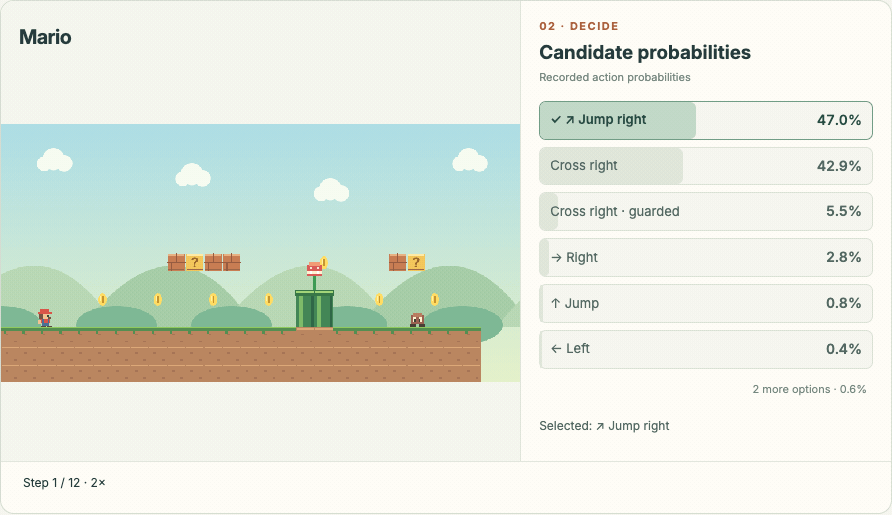
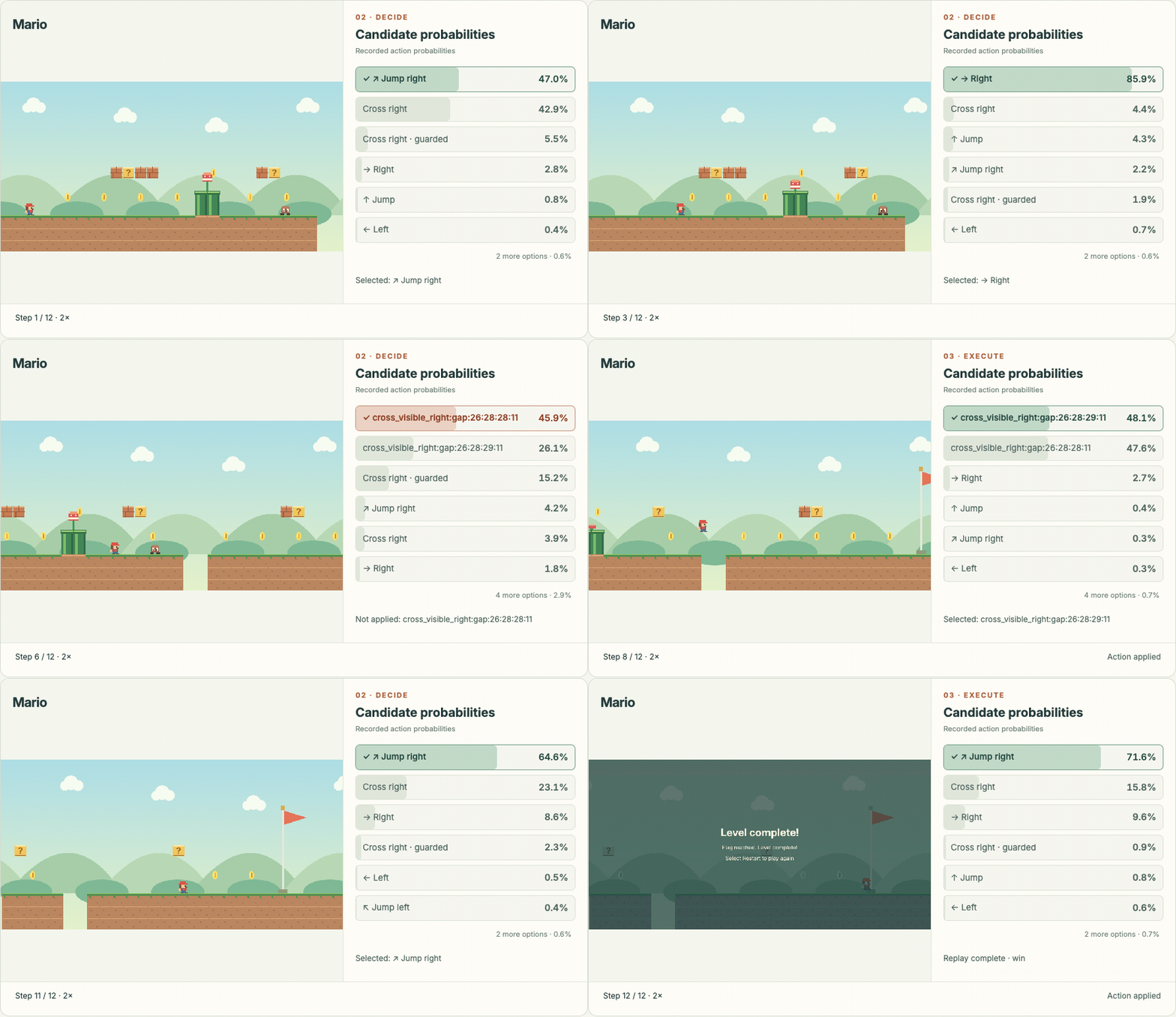
Game recordings are grouped into action, puzzle and board games. Mario tests jump timing, 2048 tests merge direction and Sokoban tests box-to-goal assignments. The 95-second Zenless Zone Zero combat recording shows the active controls alongside the character’s movements, attacks and dodges. The adjacent Black Myth: Wukong recording follows a two-minute staff fight in a forest arena.
Harness · decide what the agent may do next
Piccolo selects tools or models and checks task completion using the task requirements, permissions, budget and execution state. The workflow executes the selected action. The cases include input material, candidate actions and outcomes across tool selection, model routing, context management, permissions, completion checks and failure recovery.
Data Processing · judge the next step in a workflow
Piccolo uses source material, quality requirements and validation results to decide which records to retain, which processing plan to use, and whether an output meets the conditions for use or sharing. The cases cover data filtering, processing plans, output quality, information sufficiency, evidence and privacy, and workflow control, showing how each selected operation changes the data state.
Benchmark evaluation
Piccolo-27B-VL scores 80.22 Public, 70.97 Private and 75.59 Full on Decision Index Vision. Piccolo-9B-VL scores 71.67 Public, 65.04 Private and 68.35 Full. Piccolo-4B-VL scores 71.42 Public, 63.49 Private and 67.46 Full.
In the separate text evaluation, Piccolo-27B scores 68.08 Public and 68.40 Full, Piccolo-9B scores 60.30 and 57.34, and Piccolo-4B scores 57.14 and 50.00. The application benchmark tables report results for the foundation releases.
Full model comparison
Loading benchmark snapshot…
Method: Agentic Iteration
Training Piccolo turns model optimization into an iterative search over data recipes. The agent selects training material and supervision strategies from slice-level learning feedback. Each experiment links data provenance and semantic tags with learning dynamics and model performance, refining data selection, mixtures and processing. The resulting practices inform models across modalities and sizes.
4.1 Data curation and supervision
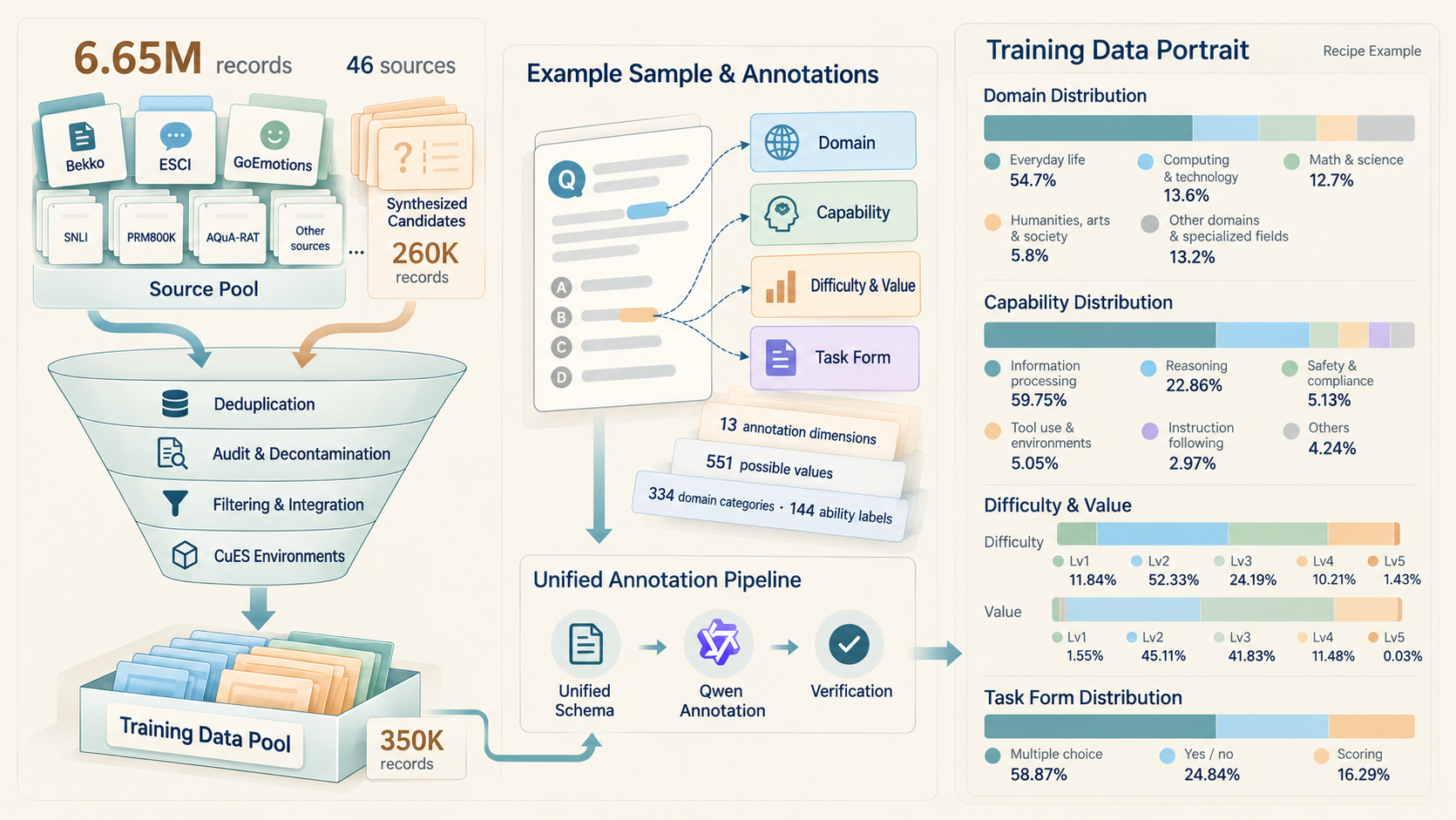
Training data covers both text judgments and joint image–text decisions. Text material is curated from 6.65 million source records, spanning classification, retrieval, mathematical reasoning, preference judgments and tool use. Image–text material adds charts, documents, spatial relationships and joint visual–linguistic interpretation. Additional environments are synthesized to construct decision tasks from state transitions, action choices and constraints. Sources share a common structure: state, question, candidates and target distribution, with images and text supplying the conditions for a decision. Hard labels express definite choices; soft labels preserve ratings, preferences and disagreement.
Data governance addresses both content quality and task validity. Duplicate material is consolidated; auditing checks question conditions, answer support, distinctions between candidates and positional bias; decontamination checks overlap with evaluation content. Image–text tasks also require checks on image availability and the correspondence between images, questions and candidates. Tool-use tasks cover both appropriate calls and decisions to decline a call, preference tasks retain complete candidate sets, and constraint-reasoning tasks make the conditions for each option explicit.
Source and synthetic data follow the same deduplication, auditing and decontamination process, retain provenance and version information, and enter the training pool.
Observable data slices: connecting data value to model learning
Qwen3.8-Max provides fine-grained semantic annotations for training examples. The data-slicing capabilities of Data-Juicer link domain, capability and difficulty annotations to individual samples. The annotation taxonomy comprises 13 dimensions and 551 predefined values, including 334 domain categories and 144 capability tags. It also records task type, decision relationships, difficulty, learning value and quality.
These tags bring data selection down to the level of specific judgments. “Computing and technology” describes a content domain, while “constraint reasoning” and “tool applicability” describe the decisions a task requires. Their intersection identifies focused slices within a broad data source. Linking those slices to per-example loss, model answer accuracy and experimental results makes it possible to track how different models learn from them at different training stages.
The training recipe illustrated in Figure 1 spans everyday life, computing and technology, mathematics and science, arts and humanities, and professional domains. Task formats include candidate selection, binary judgments and numerical scoring. Information processing and reasoning account for the main capability coverage, supplemented by tool and environment interaction, safety and compliance, and instruction following. The agent adjusts data mixtures using intersections of domain, capability, difficulty and task format. It selects material for target judgments and retains background data for existing capabilities.
The supervision objective: learning to judge among candidates
The main supervised training stage uses cross-entropy over candidate distributions. For a question with options, candidate scores are read at the answer position and normalized into probabilities , which are aligned with the target distribution : , .
Definite answers enter training as one-hot target distributions, while soft labels preserve relative preferences among candidates. Text and image–text tasks use the same candidate-decision interface. Candidate mappings, input templates and attention settings remain consistent between training and inference, so learned probabilities correspond directly to actual choices. Bidirectional attention, staged training and subsequent reinforcement learning over candidate actions use training data through this interface.
4.2 Agentic Data Engineering
The agent uses training feedback to propose data selections, mixtures and training settings for the next run. The Agentic Data Engineering system coordinates proposal design, experiment execution and analysis, recording capability changes to update data recipes. Humans set the objectives, resource budgets and permitted data scope. Agents diagnose problems, construct data and run experiments within these boundaries; auditing checks data quality, procedures and results.
Early tags and experiment records help the agent identify promising directions. As per-example loss is retained, the training process itself provides a finer view of learning. Training dynamics offer one example of how feedback leads to data adjustments.
Using training dynamics to identify further learning opportunities
Soft-label cross-entropy decomposes into the entropy of the target distribution and the divergence of the model distribution from that target: . Here, describes how dispersed the target distribution is, and measures the model's distance from it. Separating these terms gives a more direct view of how well the model fits the target judgment. Analysis follows domains, capabilities and task formats, with comparable slices organized by hard or soft supervision, candidate count and source.
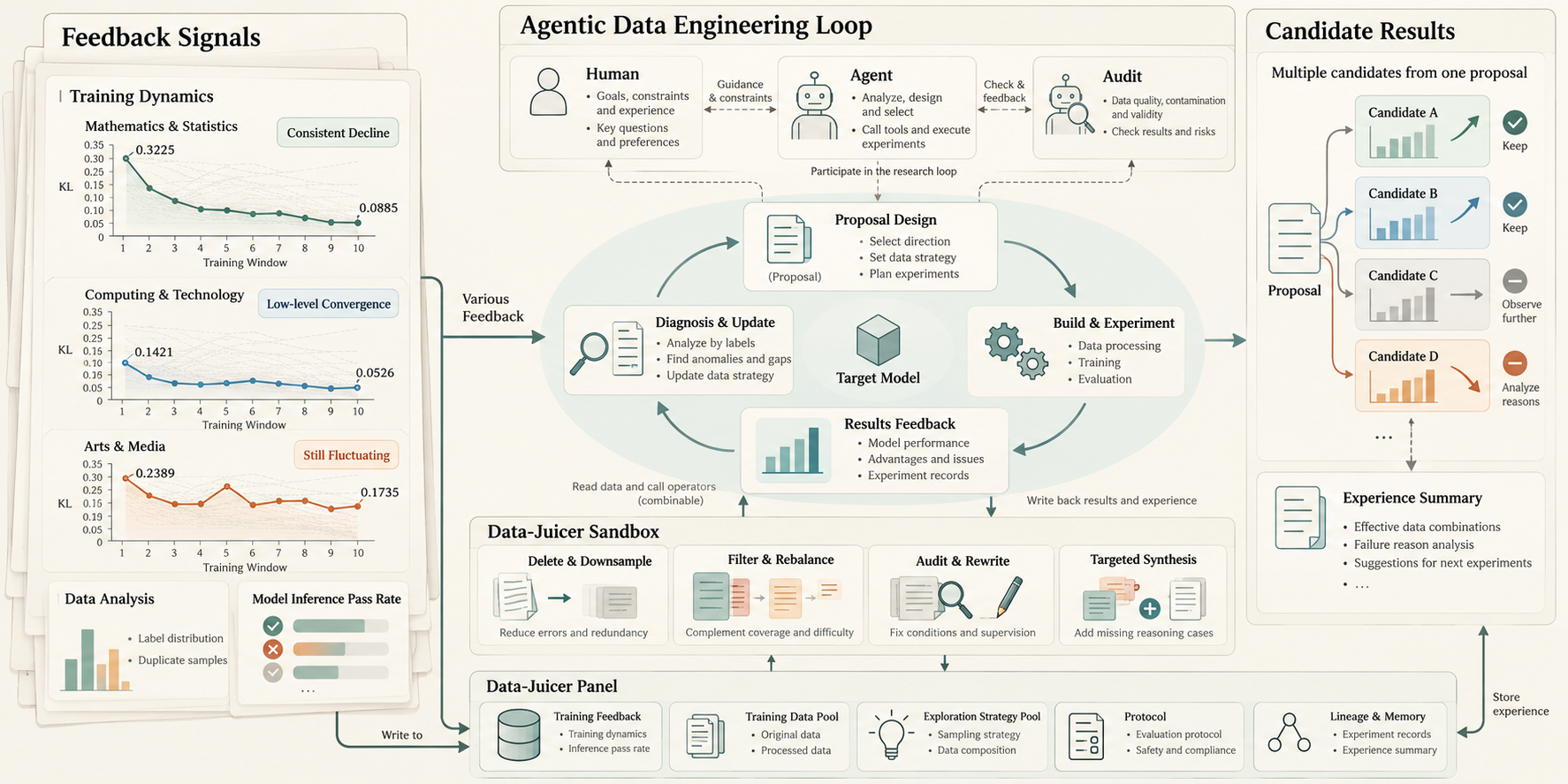
Moving from a slice to the next search step focuses on three questions: how large the divergence is, how it changes during training, and which task types account for high divergence. In Figure 2, mathematics and science show a sustained decline, computing remains relatively low, and arts and media still fluctuate. Differences averaged away in the total loss become specific questions to investigate:
Steady decline: explore the productive learning range. Broaden coverage around the same decision relationship and propose continued-training or larger-data runs to see how far the gains extend.
Low and stable: adjust repeated exposure. Reduce sampling of homogeneous templates, retain representative replay examples, and allocate more budget to slices with further learning potential.
Persistently high divergence: review supervision, then address capability gaps. Check question conditions and answers, then use semantic retrieval, mixture adjustments or targeted synthesis to add combinations of conditions the model has yet to master.
Fluctuation or rebound: examine interactions between recipes. Compare data composition, training settings and capability changes at the corresponding stages, and make the balance between targeted data and background replay a variable in the next proposals.
Organizing exploration in Sandbox, accumulating results in Panel
Built on DataJuicer-Panel, a recursive self-improvement (RSI) system for Jev decision models records the evolving lineage of data, training and evaluation. It organizes the data pool, training feedback, exploration strategies, protocols, lineage and memory shown at the bottom of Figure 2. Each experiment links its data version and parent model to its training configuration and results; new models and findings return to the asset library. A checkpoint can be traced back to its training material and upstream models, while a data slice can be followed across experiments to inspect its use and learning behavior.
The loop in Figure 2 repeatedly operates on these assets: proposal design → construction and experimentation → results and feedback → diagnosis and revision.
Each proposal specifies the target slices, data operations, training settings and comparison models. Construction produces the recipe and runs training and evaluation. Feedback captures both overall scores and changes by category. Diagnosis selects the next branches and writes effective practices and their conditions of use back into memory. Stronger models become starting points for subsequent rounds, while analysis of other branches also informs future choices.
The agent’s search space includes data-processing operators, training strategies and evaluation workflows. DataJuicer-Sandbox provides three composable modules for executing these plans: Factory supplies data-processing, training and evaluation capabilities; Hook connects an operation's inputs, execution and deliverables; Pipeline organizes operations into experimental steps. Within the agreed data scope and evaluation definitions, the agent combines operators and adjusts training strategies and execution workflows. Data operations fall into four groups:
| Data operation | Processing | Intended training effect |
|---|---|---|
| Removal and downsampling | Remove erroneous and duplicate material; adjust exposure to homogeneous examples the model has already learned well. | Allocate training budget to material with more learning potential. |
| Selection and mixing | Select examples by tags, semantic similarity and learning state; combine background, targeted and replay data. | Strengthen target capabilities while preserving existing ones. |
| Question validation and revision | Complete the conditions needed to answer, correct target labels, rewrite distractors and adjust candidate positions. | Improve supervision quality and reduce learning from missing conditions, incorrect labels and positional cues. |
| Targeted synthesis | Construct new examples around target capabilities, task mechanisms and difficulty. | Expand task coverage and create new learning opportunities. |
These operations can be combined within a single proposal. For a high-divergence slice, the agent can first review answers, retrieve related material from the existing pool and add richer combinations of conditions. Training retains background replay, and evaluation tracks changes in both target and existing capabilities.
Targeted synthesis: shaping difficulty and diversity around capability gaps
For data synthesis, we adopt the seed → construction → verification → model trial workflow of our CuES framework. The seed defines the decision relationship to learn; construction expands scenarios and conditions; verification checks answers and quality; the current model's responses guide difficulty adjustment.
Data slices and training feedback jointly guide seed selection. Tool applicability focuses on invocation conditions and alternative actions, constraint reasoning on combinations and conflicts among conditions, and preference judgments on subtle distinctions between candidates. Within each capability, domains, scenarios, numbers of constraints and distractor designs vary to cover a range of decision situations. Questions that a verifier confirms as answerable, and that the current model has yet to master, enter a candidate pool for selection by coverage, similarity and difficulty.
The current model's responses guide difficulty selection, while tag coverage and per-example feedback guide subsequent synthesis. New data passes through shared deduplication, auditing and decontamination before training. Synthetic-batch recipes, usage records and training results return to DataJuicer-Panel to inform the next selection.
4.3 Model evolution
Piccolo evolves through changes to data coverage, selection, mixtures and supervision. Figure 3 organizes representative results by exploration stage, with branches connected through data recipes, training insights and model merging. The agent uses observations from each round to select and process the next batch of material, then tests the recipe through training.
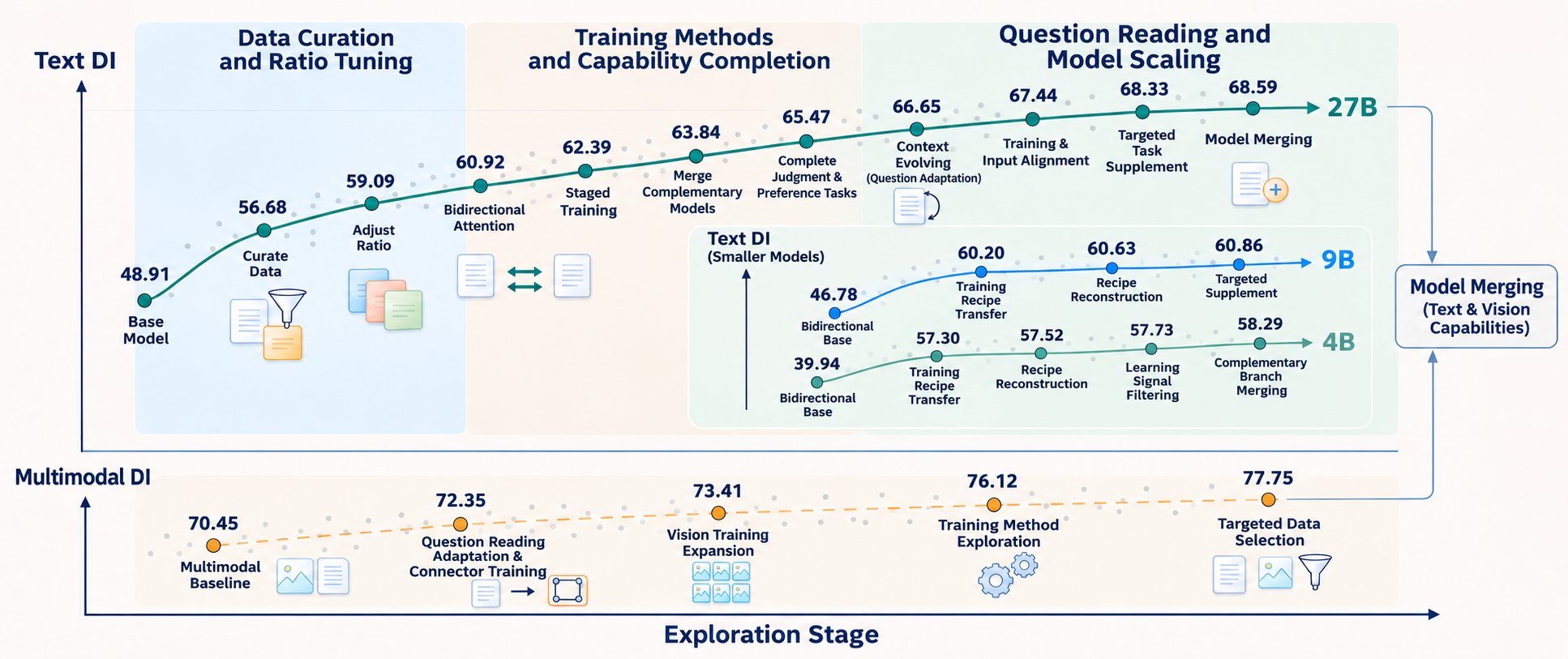
Multimodal data connects image–text understanding with decision learning
Image–text tasks make data selection sensitive to combinations of visual information and decision conditions. Charts and documents, spatial relationships, counting and joint visual–linguistic interpretation strengthen different judgments; targeted examples and capability replay form the training mix. Early exploration adjusts the organization of images, questions and candidates, then trains the visual connector and visual capabilities, improving multimodal Decision Index Public from 70.45 to 73.41. Candidate probabilities and category-level performance subsequently guide the selection of targeted examples and replay material for reinforcement learning.
Data selection establishes the initial capability foundation
The 27B base model scores 48.91 on text Decision Index Public, rising to 56.68 after initial data curation and training. The agent then adjusts the proportions of background and targeted material using semantic tags and continues training from stronger models, reaching 59.09. Data selection develops from source-based mixtures into selections informed by task coverage and model performance. Subsequent experiments reuse these recipes and adjust the proportions of background and targeted material.
Better-aligned training and inference methods broaden how the data can be used
Bidirectional attention lets information within the input interact, candidate supervision aligns learning with decision outputs, and staged training separates broad coverage from targeted strengthening. Representative text results reach 60.92 and 62.39; semantic retrieval, preference and tool-use tasks, background replay and model merging then advance performance to 63.84 and into the 65-point range. Further data selection and supplementation, together with alignment of training inputs and attention settings, produce representative text results of 66.65, 67.44 and 68.33, reaching 68.59.
Input organization also provides supplementary observations. Context Evolving explores how question–context order, question-first layouts and repeated reading affect responses. In a comparison using the same model weights, input and inference changes increase full-suite text Decision Index Public from 65.05 to 66.19.
In the multimodal setting, reinforcement learning further adjusts how strongly the selected image–text examples shape learning. The agent selects examples using correct-candidate probabilities and source coverage, samples actions from the valid candidate distribution, assigns correctness rewards and updates candidate probabilities with group-relative advantages. Capability replay uses cross-entropy, with a KL term to the parent distribution constraining updates. Candidate actions share a single forward pass. Under the same evaluation settings, a candidate GRPO branch improves multimodal Decision Index Public from 77.03 to 77.30, and subsequent selection-weighting and replay experiments reach 77.35.
These multimodal models also support supplementary Weight-Space Exploration: fixed weight transformations of modules and local channels are selected through forward evaluation and incorporated into a deployable checkpoint. One branch starting from the 77.30 RL model advances the multimodal result to 77.75. The observations accumulate alongside data recipes and model performance to inform subsequent data selection and training. Further multimodal exploration includes targeted data supplementation and reinforcement learning. The latest released models achieve Public scores of 79.97 (27B), 71.76 (9B) and 71.55 (4B).
Model merging reuses capabilities from complementary branches
Branches specialize in knowledge, preference judgments or tool use, and complementary models are selected from their category-level performance. In one text experiment, merging five branches reaches 63.11 on full-suite Decision Index, versus 62.78 for the strongest individual branch at that stage. A merge of image–text and text branches yields a single model scoring 68.19 on text Decision Index Public and 73.03 on multimodal Decision Index Public. Branch checkpoints, recipes and category-level results are retained for subsequent training, merging and experiment selection.
Extending the same data-engineering approach to 4B and 9B
Using the same candidate-decision interface, 9B improves on text Decision Index Public from a base score of 46.78 to 60.86, while 4B advances from 39.94 to 58.29. As model size changes, the agent uses tags and response feedback to adjust difficulty, data mixtures and replay proportions, alongside continued training, complementary-branch merging and model adjustment. The tag taxonomy supplies common observation dimensions, while each size’s learning behavior guides its own recipe.
Three lessons from the exploration
Select data by decision relationship. Conditional constraints, tool applicability, image–text correspondence and candidate preferences guide data supplementation; model learning feedback guides adjustments to the mix.
Match supervision to the data. Definite labels, soft preference distributions and candidate-action rewards organize different learning signals, with targeted examples and capability replay jointly shaping updates.
Reuse exploration branches. Subsequent experiments continue training or merge existing checkpoints, using each branch’s recorded data recipes, category-level results and conditions of use.
Built-in benchmarks
We built benchmarks for Harness, Data Processing and Game settings to evaluate decision models in agent execution, data workflows and sequential gameplay.
HarnessJevBench
We designed HarnessJevBench to test the decisions that control an agent’s execution: which tool or resource to use, what context to retain, whether an action is authorized and whether the evidence supports completion. Each case supplies the state, evidence and rules, so each decision can be evaluated individually. The benchmark covers six scenario categories and 29 task types, with 325 evaluation cases in total.
Piccolo-27B achieves 84.41% Hard accuracy, a macro average over 295 determinate-answer evaluation cases, and 0.2175 total variation distance from the reference distributions. It scores 96.08% on completion and evidence checks, 93.22% on permissions and trust boundaries, and 70.00% on resource allocation.
DataJevBench
We designed DataJevBench to test decisions inside data workflows: admit a record, select a processing plan, assess an artifact, check whether evidence is sufficient, verify a claim or choose the next action. The 500 tasks make these judgments explicit, with 480 choice and 20 ordered-scoring questions across six subsets.
Piccolo-27B reaches 82.60% accuracy (413/500), exceeding 80% in five subsets. Artifact quality reaches 92.50% (74/80) and information sufficiency 82.00% (82/100); workflow control reaches 91.67% (55/60). Overall ECE10 is 0.0746 and Brier is 0.2681. The repository provides the task definitions, probability metrics and full results.
Future directions
We will continue studying how training and evaluation feedback can guide the next experiment, while strengthening Piccolo’s cross-modal capabilities and its performance over longer decision sequences.
Improve RSI exploration efficiency
Compare experiment-selection strategies through training and evaluation cost, candidate adoption and recipe reuse to make better use of a fixed budget.
Strengthen cross-modal capabilities
Strengthen decision models’ ability to understand and jointly reason over information from text, images and other modalities.
Improve long-horizon and real-time decisions
Improve the coherence of multi-step actions and end-to-end task performance in games, computer use and browser use.
Expand System 1 primitives
Develop additional structured decision primitives alongside choice, score and noul, with corresponding supervision and evaluation.
CONTINUE EXPLORING
See what the next choice does.
Resources & further reading
Models and project code.
Piccolo model weights.
Piccolo downloads and usage guides.
Original benchmark and evaluation protocol.
The original Decision Index leaderboard.
Harness tasks, methodology and results.
Data workflow tasks and evaluation.
Organizes research agents that propose, execute and analyze data experiments.
Processing, annotation and data slices.
Organizes data processing, training and evaluation into executable experiments.
A framework for exploring environments and constructing training tasks from interactions.